The 9th Taiwan Blockchain Summit, with support from the Ministry of Digital Affairs, the National Development Council, and the godfather of Bitcoin cryptography
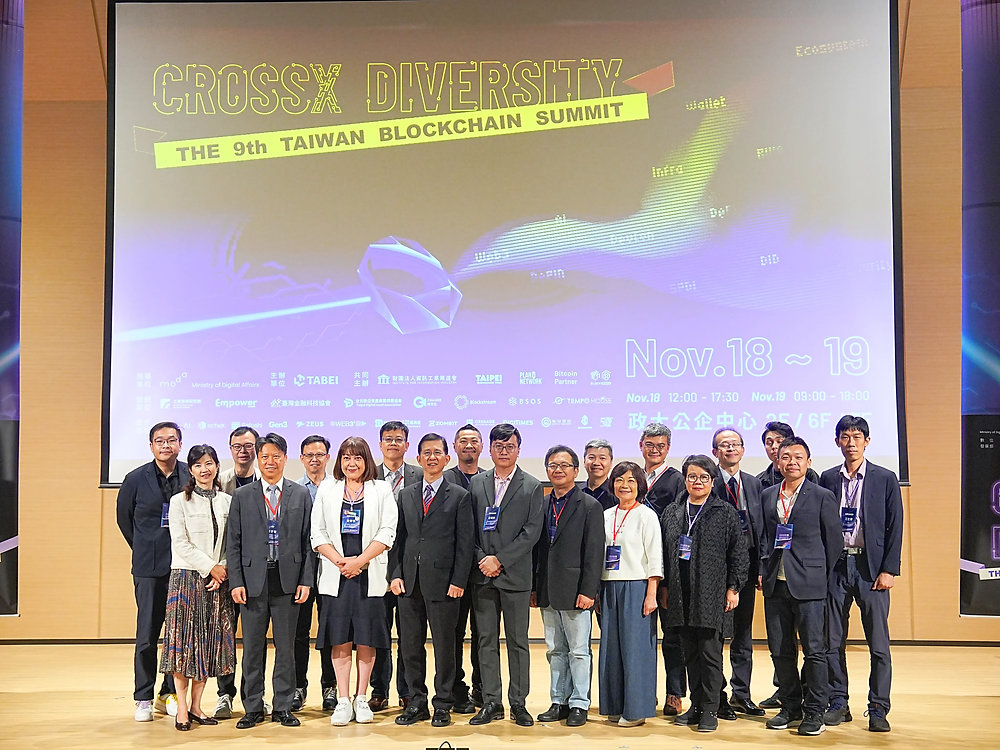
The 9th Taiwan Blockchain Summit opened on 18 November under the theme "Cross X Diversity", emphasising cross-sector collaboration and diversity as a way to meet a changing global environment and to take up the opportunities of the digital economy. Held under the guidance of the Ministry of Digital Affairs, the summit combined its programme design, new event formats, and in-depth discussion to encourage Web2 and Web3 to build and prosper together, and to explore where Web3 can be applied across fields. Many figures from industry, academia, and government took part, among them Minister of Digital Affairs Huang Yen-nun, National Development Council deputy minister Chan Fang-kuan, Bitcoin cryptography pioneer Adam Back, and Chen Mei-ling, chair of the Taiwan Foundation for Regional Revitalization. In his address, Minister Huang Yen-nun looked back at the limits of the Web2 era: because attention went largely to large platforms such as Google and Facebook, Taiwan's role was constrained. In the Web3 era the picture has changed, no monopoly has formed, and Taiwan has a fresh opening. Huang stressed that decentralised technology can help rebuild trust online and address the spread of fraud and disinformation. He was also positive about combining Web3 with AI, calling it an important opportunity for Taiwan to be competitive again in the global technology wave. This was the first talk in Taiwan by Adam Back, the Bitcoin cryptography pioneer once thought to be Satoshi Nakamoto. He said blockchain is the technology best suited to building financial transactions, completing a transaction with the smallest possible amount of data. For his keynote on the second day, he said he would introduce the audience to the history of Bitcoin and to the technical and scientific questions that preceded it, so they could understand how today's blockchain technology came about. National Development Council deputy minister Chan Fang-kuan recalled that at the third summit the discussion was about applying blockchain to civil-service rewards and discipline; seeing how far it has come since, he noted how much has changed, that blockchain has gradually entered public view, and that many applications are now widespread. He thanked the summit for years of steady work and said the council would continue to support startups and international connections. Kao Chi-chun, chair of the Taiwan Blockchain Enthusiasts Association, said that since its founding the association has worked on co-creation between Web2 and Web3 and has actively promoted public education and cross-disciplinary exchange. It has become a bridge for industry, government, academia, and research, and reaching a ninth summit is no small achievement. With guidance over the years from the government, the Executive Yuan, the National Development Council, the National Science and Technology Council, and the Ministry of Digital Affairs, the association has grown into a platform for exchange among government, business, technologists, investors, and developers. It has built consensus across sectors and played an important part in Taiwan's contribution to global Web3 innovation. Beyond the summit, it also supports startups and cross-disciplinary research, working to build an active blockchain community and bring new energy to the industry. This year's programme combined new event formats with in-depth sessions, focusing on where Web2 and Web3 can create together and building a bridge between the two. Participants explored where Web3 applies across a range of settings and, on a basis of cross-sector collaboration and diversity, took up the challenges and opportunities of the digital economy.