At the Taiwan Blockchain Summit, exploring how PayFi joins Web2 and Web3 innovation
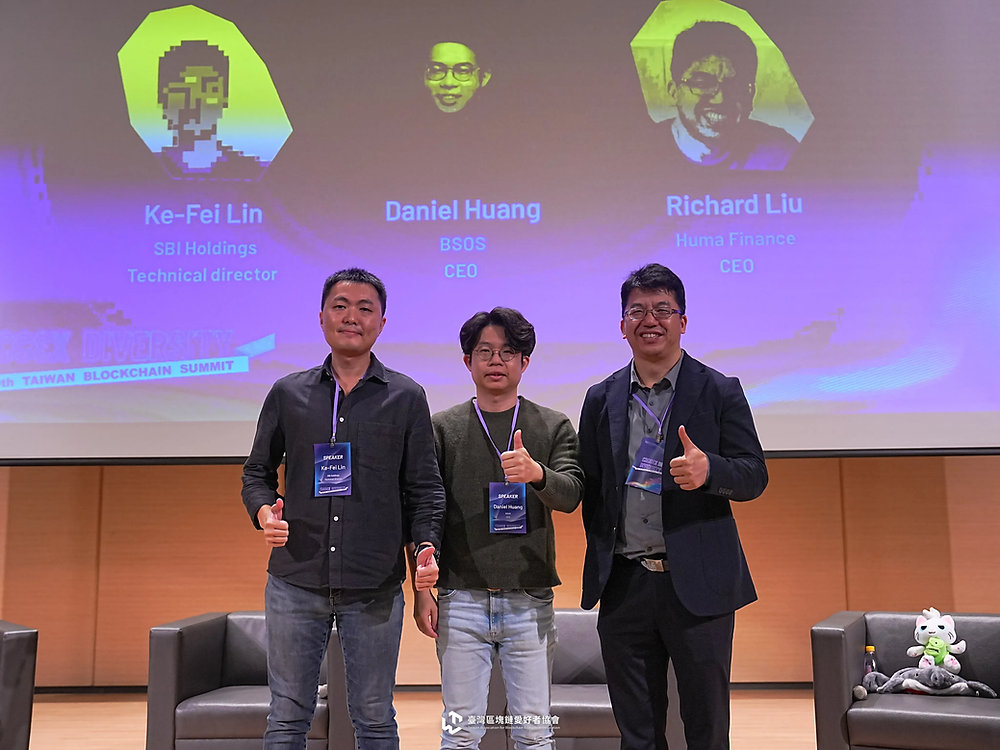
The Taiwan Blockchain Enthusiasts Association held the 2024 9th Taiwan Blockchain Summit on 18 and 19 November under the theme "Cross X Diversity", focused on cross-sector integration and diverse innovation and on where Web2 industry and Web3 startups meet. One panel examined PayFi as a catalyst for financial inclusion and its potential in real-world use. How is blockchain changing payments and finance, now and ahead? Real World Assets (RWA) means turning traditional assets into crypto assets on a blockchain. PayFi, a term proposed by Solana Foundation president Lily Liu, aims to use blockchain for instant settlement without a clearing process, raising transaction efficiency. The panel brought together Lin Ke-fei, technology director at SBI Holdings; Daniel Huang, chief executive of the financial services provider BSOS; and Richard Liu, chief executive of the on-chain protocol Huma Finance, to discuss how tokenisation and PayFi can accelerate financial inclusion. Blockchain enables peer-to-peer payment, raises payment efficiency, lowers costs, and improves transaction security, and its commercial use is accelerating. Opening the panel, Daniel Huang said the blockchain industry is moving towards practical application, with stablecoins as one success. He stressed that blockchain can address not only payment efficiency and cross-border payment but also offer a new answer for financial inclusion, particularly through PayFi. BSOS chief executive Daniel Huang analysed current RWA trends. PayFi uses blockchain and stablecoin technology to improve existing payment-finance services such as credit-card financing and cross-border payment. Its composability allows different payment-finance services to be assembled like building blocks into entirely new applications — the combination of stablecoins and smart contracts, for example. PayFi would markedly improve cross-border payment, shortening settlement from T+3 or T+4 to T+1 and potentially to T+0. Tokenising corporate bonds would also let investors buy with stablecoins and use the bonds as collateral for trading or lending. Blockchain lowers the cost of advancing funds in the traditional financial system, improves the velocity of capital, and opens the way to further applications. The outlook for payment and financial services Blockchain is genuinely affecting everyday finance and will matter in payments ahead. Even so, PayFi faces challenges, and compliance and market education are among the questions still to be settled. How, then, does blockchain reach financial inclusion? Richard Liu said the high entry cost of traditional financial assets is the main obstacle; if blockchain can lower the cost of investing so that ordinary investors can take part, that will be an important force for inclusion and will widen access to finance further.