Fidelity, Tether, Maxtriport, and BSOS gather at the Taipei RWA forum: experience with RWA and the convergence of Web3 and financial institutions
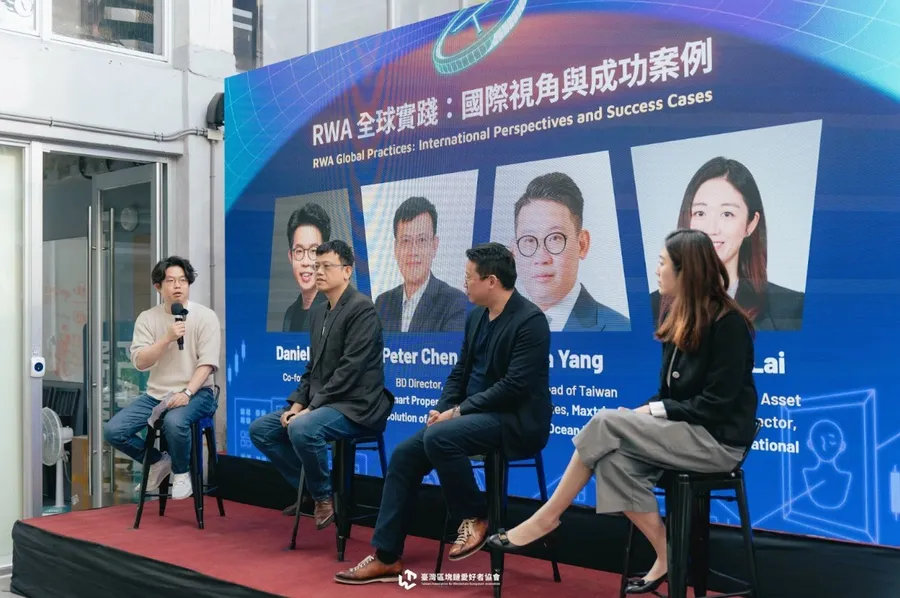
Source: WEB3+ Taiwan Stablecoin and Real World Asset Tokenisation Forum: Fidelity, Tether, Maxtriport, and BSOS gather at the Taipei RWA forum The Taiwan Stablecoin and Real World Asset Tokenisation Forum was held at N24 Taipei ARK on 2 April. Daniel, chief executive of BSOS, chaired the session "RWA in practice worldwide: international perspectives and successful cases", joined by three industry figures from Fidelity International, Tether, and Maxtriport for a discussion of global progress in RWA and Taiwan's opportunities, seen from traditional finance, stablecoin issuance, and a Web3-native standpoint. As the RWA conversation shifts, is there still a role for Web3-native teams? Daniel opened by noting: "RWA started as a crypto idea, but over the past two years the conversation has moved back to traditional financial institutions, because they have the asset scale and the credit standing. Given that shift, what role is left for Web3 natives?" Ethan Yang, Maxtriport's head in Taiwan and co-founder of Ocean Finance, answered: "Trust is the core of finance. On-chain assets such as BTC or ETH can secure trust through smart contracts and private keys, but RWA is different: beyond control of the token, you have to guarantee a strong link between the token and the real-world asset. That link usually rests on the custody arrangements and bankruptcy-remoteness protections of traditional institutions such as Fidelity and BlackRock. Traditional finance has deep experience in reinforcing trust. Tokenising is securitising — only the vehicle differs, and they already have good frameworks." Where, then, is the value of a Web3-native team? Beyond technical services — helping build tokenisation platforms, supervisory processes, fund-flow tracking, and other blockchain infrastructure — Ethan Yang said the more important point is that Web3 companies understand how to make an RWA token come alive, and that this is Web3's core know-how. "Professor Hsieh Ming-hua said at the opening that RWA must avoid island-style issuance," Ethan noted. "The worst RWA is one that nobody buys. The next worst is one that people buy and then hold to maturity, with no trading and no other use. If that is all it is, you may as well use a trust or a fund certificate from traditional finance — why tokenise?" He gave an example: "The first tokenised fund was not BUIDL but Franklin Templeton's, and Franklin took five years to reach US$360 million in AUM, whereas BlackRock's BUIDL reached US$1.8 billion within a year. The difference was Web3 teams such as Securitize, Ethena, and Ondo joining in to build a complete liquidity mechanism. The point of tokenisation is what you can do with it — payment, lending, collateral — and that requires liquidity. Traditional institutions do not understand Web3 well enough, so beyond technical services the more important job for Web3 companies is guiding them on how to connect to Web3 liquidity and issue RWA tokens people actually want." How traditional finance joins blockchain: Fidelity's path Daniel then asked: "Fidelity is one of the largest asset managers in the world and has moved into blockchain in recent years. How do you see RWA's potential, and what have you actually explored?" Giselle Lai, director of digital asset investment at Fidelity International, said: "Fidelity International's vision for RWA is to give investors a safe, trustworthy window into digital assets. We also see blockchain's potential for financial inclusion." Fidelity's RWA work runs along two main lines: - Fund tokenisation: improving trading efficiency and liquidity, and opening new allocation options for investors. - Real-asset tokenisation: more assets will be issued on chain in future, and how a portfolio takes them in is the question of financial infrastructure we are studying. She noted that Fidelity has taken part in several significant RWA projects, piloting with regulators and financial institutions to understand how an RWA lifecycle works under supervision: Investing in the Hong Kong government's tokenised green bond, the first of its kind in the world Joining the Monetary Authority of Singapore's Project Guardian Joining the Hong Kong Monetary Authority's HKD pilot programme Tether's strategy: from infrastructure to creating liquidity Tether, the largest stablecoin issuer in the world, also draws attention on RWA. Daniel asked: "What is Tether's RWA strategy at present, and how do you see this market?" Peter Chen, business director at Tether, set out three directions: Direction one: the Hadron technology platform Over the past decade USDT went from zero to US$140 billion in issuance. Tether has folded that know-how and technology into the Hadron platform, which gives financial institutions a complete issuance stack covering AML/KYC, automated minting, and bank integration. He stressed: "This is not something Tether can do alone. It needs more local partners like BSOS working with us to widen the ecosystem." Direction two: Liquid Network, a Bitcoin layer 2 Tether works with Blockstream to promote the Liquid Network ecosystem. "People used to say Bitcoin's technology was not flexible enough, but after several security incidents it turns out Bitcoin remains the most secure and reliable. For RWA, a chain built on Bitcoin technology such as Liquid Network has a security advantage." Direction three: the Bitfinex Securities liquidity platform Independent of Bitfinex, this platform focuses on STOs, RWA tokenisation, and other trading backed by real financial assets, covering both primary issuance and secondary trading. By asset class, customers are most comfortable with US Treasuries and gold — assets whose value needs no explanation. In future, subject to the relevant approvals, it may also be possible to buy RWAs of Nasdaq-listed stocks such as MicroStrategy. Tether has accumulated a great deal of experience through Web3's history and has consistently provided secure technical support. Peter added: "We can help traditional institutions onboard quickly. Once the platform is secure, liquidity is the key, and that is where our attention is." What comes next for RWA? Could Taiwan become an RWA exporter? In the second round, Daniel asked Ethan to assess international progress and Taiwan's opportunities. Ethan said international RWA is concentrated in financial assets such as Treasuries and funds, because: - They are highly standardised: every tokenisation carries a cost, but financial assets can be issued in further tranches without reworking the legal framework, and bond structures are similar, so the marginal cost is low. - Market acceptance is high: financial assets are already virtual — numbers on a ledger — so moving from a number to a wallet token is painless. Tokenising real assets such as property, art, or intellectual property differs from what investors are used to, and there is psychological resistance. The next breakthrough will come from: - A wider range of assets: financial assets alone are of limited interest. Tokenising film rights, real estate, and patents is more interesting. - Cross-border trading platforms: exchanges did a great deal for crypto over the past decade, whatever the criticism about decentralisation. RWA likewise needs large platforms where global assets can be bought and sold with conversion and lending support before it becomes widespread. Ethan then set out Taiwan's advantage: "Taiwan has been an importer of financial products — offshore funds, offshore insurance policies, US Treasuries — because yields were low and the market small, so Taiwanese institutions struggled to sell abroad. RWA is a chance for Taiwan to become an exporter. Taiwanese equities have performed well since the pandemic, and funds such as Yuanta's technology funds rank among the best-performing global equity funds, yet foreigners find them hard to buy and mostly know only the TSMC ADR. RWA gives Taiwanese institutions a way to issue products overseas. We should not sit this one out." The biggest obstacle to institutional participation is understanding Daniel shared his own observation: "When we discuss RWA with institutions, the first ninety minutes of a two-hour meeting often go on explaining blockchain basics, leaving thirty minutes for the product. Assets used to be recorded in the institution's own database; with RWA the record sits on an external ledger controlled only by the user's private key. That really is a large conceptual leap." Giselle replied: "Education matters a great deal. Fidelity in the US began studying blockchain ten years ago, and we started mining Bitcoin in 2015 to understand the technology. In 2022 we set up a blockchain team, studied applications, and increased the budget. Internally, Fidelity put considerable effort into cross-departmental blockchain training so people understood the differences. We also invest in Web3 teams through our venture arm, which gives us first-hand market information, fills gaps in the ecosystem, and helps us understand where things are going." She stressed: "All of it comes back to one thing — client demand. When there is demand in the market for tokenised funds, we will push that line forward." Convergence: Web3 and traditional finance building a new market together Daniel closed by asking Peter: "There are more and more collaborations like Securitize and Ethena, and Web3 and traditional finance no longer regard each other with suspicion. Convergence is the biggest change I have seen in the past year. What cross-sector experience does Tether have?" Peter said: "The crypto industry and banks used to be far apart, but policy has loosened in recent years — the positive, open stance of the Trump administration in the US towards digital assets, for instance, has opened space. On working with governments, our focus is on emerging countries such as El Salvador. There is no traditional financial base there, so they are more willing to try blockchain solutions." He added: "I went to the Plan B Forum in El Salvador earlier this year and was struck by how fully the government is behind digital assets and high-technology industry. Google has an office building there, large financial institutions are moving in, and Tether will continue to commit resources — some of our headquarters functions may even move there." Looking to 2025: the year RWA gets real The speakers each offered a view of RWA this year: Ethan: "This is the institutional year. The success of BUIDL and USDY has shown the financial world the opportunity, and with policy loosening it will be an important turning point." Giselle: "I expect more institutions to join RWA. Liquidity, on-chain interoperability, and regulatory differences between jurisdictions are still to be resolved. Combining stablecoins with RWA will be key. It is an exciting moment." Peter: "Tether has rarely appeared in public, but we are willing to support Taiwan — within what policy allows and in full compliance — in taking good projects international and helping capital return to Taiwan. That is what we are most looking forward to this year." Daniel: "Convergence is not merely a trend but something happening now, and it will reshape the RWA landscape and the roles everyone plays in it."