A recap of the 7th Taiwan Blockchain Summit: seven sessions in one place
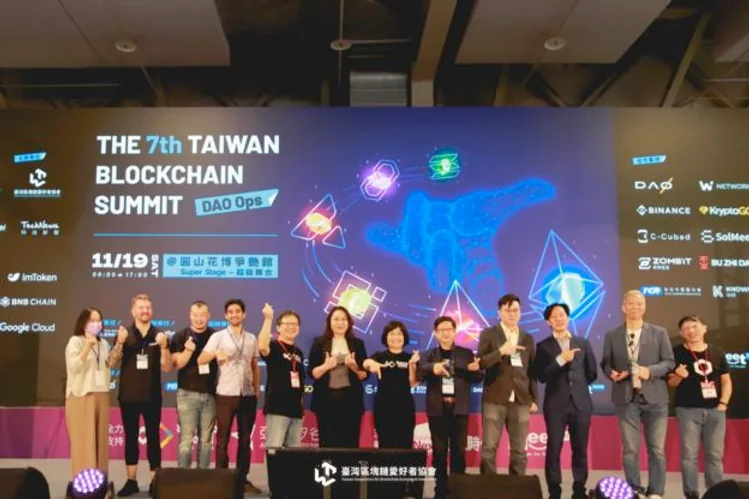
The 7th Taiwan Blockchain Summit closed on Saturday 19 November at the Expo Dome in Yuanshan. It drew a large crowd of blockchain enthusiasts, and even the turmoil at the FTX exchange did nothing to shake their conviction. All 150 seats on the Super Stage were taken, with people standing in the aisles to hear about the newest blockchain trends and industry applications. Opening remarks came from Chan Ting-yi, honorary chair of the Taiwan Blockchain Enthusiasts Association; Chen Mei-ling, convener of the Taiwan Blockchain Alliance; and Lin Chung-chieh, commissioner of the Taipei City Department of Economic Development. Chan Ting-yi observed that in a challenging and volatile period, blockchain developers and enthusiasts everywhere want a clear and predictable supervisory direction; the US government had recently signed several executive orders whose emphasis on consumer protection, responsible technical development, and blockchain applications Taiwan can learn from. She added that blockchain is not only cryptocurrency: the blockchain ecosystem is already applied in many settings, and in recent years blockchain organisations have increasingly operated as DAOs — which is both the theme of this year's summit and a response to where the field now is. She hoped the ecosystem would stay flexible, encourage transparency, protect consumers, and grow more mature and more trusted. Chen Mei-ling encouraged the audience by noting that, with time, it is clear FTX was a single event; the impact on the industry was severe, but what can be done now is to watch how matters develop and to secure whatever protections are available. "A bird on a branch does not fear the branch breaking, because it trusts that it can fly," she said, adding that the industry will move forward the stronger for having been tested. She also drew a lesson for crypto startups: openness, transparency, and regulatory compliance matter greatly, and she strongly commended Taiwan's three major exchanges for issuing a joint public statement about building a better ecosystem. Blockchain technology is neutral; its core values are responsibility, credit, freedom, and transparency, and holding to them gives good reason for confidence in the ecosystem. Lin Chung-chieh said cross-sector co-creation is the key to blockchain's continued development, and that trust, inclusion, and openness are the values the Taipei City Government promotes; through connection and matchmaking it hopes to make Taipei the main base for blockchain in Taiwan and to link it to the world. ▲ The audience (Source: Taiwan Blockchain Enthusiasts Association) The programme opened with the panel "da0 x Commons", chaired by da0 founder Noah Yeh, with Benjamin Illies, event strategy manager at Protocol Labs, Evan Miyazono, head of its research team, and Isabel Hou, rotating chair of the g0v Summit team, on how Web3 technology and public goods fit together. The panel noted that we need a sustainably expandable and stable economic model to reward those who work on public goods, and that the hypercerts project now attracting attention abroad is trying to solve exactly this. If a company promises to plant 50,000 trees over five years, it can buy a hypercert in advance and obtain the associated tree-planting NFT; when partners actually plant the trees, they receive the NFT as proof that the promise was kept. All of it is public on chain, so public-interest work is no longer a slogan but something that can be inspected and its results tracked. ▲ First session: da0 x Commons (Source: Taiwan Blockchain Enthusiasts Association) The second session, chaired by honorary chair Chan Ting-yi, brought together Nicholas Yang, head of the blockchain team at Cathay Financial Holdings' Data and Digital Development Center; Chi-Ming Peng, secretary-general of the Taiwan Climate Partnership; and David Chen, associate director of business development for Greater China at Nasdaq, on how to build a decentralised alliance together. Nicholas Yang described bringing fourteen property and casualty insurers in Taiwan into an alliance that shares claims data in a decentralised way on a blockchain, exchanging information digitally with peers in finance and insurance. Cathay Financial Holdings has been growing into a technology company with Web3 strengths, working through regulatory and other settings to put decentralised alliances into practice. Chi-Ming Peng said that beyond insurance, climate and carbon-inventory data sharing is another field that must connect to blockchain. The UN Environment Programme has likewise said that transparent clean energy, carbon markets, and climate finance all need blockchain support — particularly now, when companies need blockchain to evidence their sustainability data. David Chen said Nasdaq began exploring blockchain in 2015 and two months earlier had announced the launch of Nasdaq Digital Assets to power the digital-asset ecosystem and encourage broader institutional participation, with an emphasis on custody, liquidity, and integrity; a digital-asset exchange may follow. ▲ Second session: how to build a decentralised alliance (Source: Taiwan Blockchain Enthusiasts Association) The first keynote was given by Damien Ho of Binance's global partnerships team, on how companies and institutions should meet and embrace the Web3.0 era. Drawing on his own experience, he urged that alongside considering Web3 partnerships, organisations should weigh the challenges they bring, start from integrating their own applications, keep competitiveness at the centre, and move deliberately into Web3. Binance has worked with leading schools worldwide to provide blockchain education and develop future talent, and has built local communities — Binance Blockchain Week, which had just finished in Paris, was devoted to bringing together new technology, new communities, and new enthusiasts, and is an effective entry point into Web3. Damien added that understanding the regulator matters: knowing the government's concerns, proposing solutions, and communicating are all important, and companies should also reflect, test, and avoid foreseeable problems, so that everyone can coexist and build together in the Web3 era. ▲ First keynote: how companies and institutions should meet and embrace the Web3.0 era (Source: Taiwan Blockchain Enthusiasts Association) The third session looked at how new on-chain data draws capital into Web3 and creates a new economy. Chair Kao Chi-chun said Web3 is currently an unregulated digital jungle, stacked up worldwide like a game of Jenga: pull one block badly and the rest come down with it. Stakeholders therefore need workshops to build industry consensus, discuss how work should be divided, co-build a decentralised and sustainable industry protocol, and put up firewalls, so the industry becomes resilient. Founder Wen Hung-chun described three years of building from Web1 capital to Web3: Web1 through Mafia Capital, reading information asymmetry to create investment opportunities and advisory services; Web2 through New Economy Ventures, finding opportunities with a data-driven approach; and Web3 through Kryptonomics Ventures, continuing to build through the bear market in the Web3 spirit of DAOs and on-chain governance. Kenneth Tu noted that Chainlink, as the trusted oracle for large-scale Web3 adoption, has built many trust-minimised Web3 service platforms that reduce the risk of centralised data governance — on-chain randomness (VRF) and proof of reserve among them. Designed around a pay-per-use model for data supply and demand, it has succeeded in creating a decentralised data economy. Justin Wang described forming Solana Meetup (SolMeet), which has run monthly Solana workshops — more than fourteen so far — using foundational technical courses to build a working rapport among developers, and holding large hackathons to attract more support and resources from foreign foundations. ▲ Third session: how to build a decentralised alliance (Source: Taiwan Blockchain Enthusiasts Association) The second keynote was given by C-Cubed founder William Pacaz on co-creating the Web3.0 fan economy. NFTs, he said, are not a way to make money but should be seen as a highly workable marketing tool. Among their many uses, membership cards and organisational identity are excellent examples of blockchain's decentralisation, consensus, and transparency. Using an NFT as a membership card allows a brand to track members' preferences, analyse behaviour patterns, and build new kinds of marketing. A decentralised model also lets members treat the product as their own and care more about their relationship with the brand. "We like to build together" is the culture of the Web3 community: people enjoy giving feedback and taking part, which creates a strongly cohesive group that will organise its own events online and offline. NFTs add to brand marketing through a marketing circle of gathering feedback, viral spread, and borderless promotion. Through the Web3 ecosystem and the decentralised idea at blockchain's core, a new kind of marketing can shape the fan economy of the future. ▲ Second keynote: co-creating the Web3.0 fan economy (Source: Taiwan Blockchain Enthusiasts Association) The fourth session was chaired by Charlotte Jao, public relations director of the Taiwan Blockchain Enthusiasts Association, with Hank Huang, CTO of Kronos Research, Bill Hsu, investment analyst at Kronos Ventures, and Damien Ho of Binance's global partnerships team, on going from zero to a hundred: incubating a Web3 startup through to a token listing. Bill Hsu said Kronos Ventures was founded in 2021 and focuses on early-stage seed investment, having completed more than sixty deals across areas beyond trading and DeFi, including the metaverse, NFTs, and GameFi. "Because blockchain code is open source, product development is more open and more competitive; only community cohesion and the handling of key topics can show that a project is irreplaceable." The top forty crypto projects by market capitalisation correlate with the volume and intensity of keyword discussion in forums, and new teams should think about building real community energy. Hank Huang said that in the zero-to-one stage a team should concentrate on business development and creating commercial value, and that core product development should align with the team's overall goals; shaping a company culture and conveying its values drives the team's all-round growth. Damien Ho added that since 2018 Binance has worked with partners to complete the Web3 ecosystem. Binance Labs, a fund of some US$7–8 billion, has invested in more than two hundred projects across DeFi, infrastructure, GameFi, NFTs, SocialFi, wallets, and security. It also acts as an incubator, giving selected projects eight weeks of mentoring with opportunities for one-to-one exchange and resource sharing with Binance's core team and partners. Damien said Binance Labs currently assesses projects against four criteria: users, business model, team, and benchmark. ▲ Fourth session: from 0 to 100 — incubating a Web3 startup through to a token listing (Source: Taiwan Blockchain Enthusiasts Association) The fifth session was chaired by Chen Ting-yuan, secretary-general of the Taiwan Blockchain Enthusiasts Association, with Huang Tou-ni, founder of FAB DAO, Tiffany Lai, co-founder of Bu Zhi DAO, and Peng Tzu-hsi, founder of the Bored Ape Club Taiwan, on whether operating as a DAO means community plus company. Huang Tou-ni, a doctor who moved into Web3 non-profits, compared Web3 to the steppe, traditional companies to an Islamic empire, and communities with different values to nomadic peoples, to convey the resilience and strength of plural values in the Web3 world. A DAO consists of a shared goal, a common treasury, and a group of people who share the same beliefs, and how that triangle solves and completes a particular task is the core of the DAO's cooperativism. He noted that platform economies were built on platform capitalism, in which the operating company monopolised the value all users provided; in Web3 that turns into a DAO of people jointly managing the platform and sharing its value, producing a new platform cooperativism. Tiffany Lai said DAOs have much in their organisational culture that traditional companies cannot match. In a traditional company it is hard to communicate across departments and hard for resources to flow between them; in a DAO those barriers are much weaker and exchange is smoother. She also noted that some Bu Zhi DAO contributors come from large Web2 technology companies and are hesitant about moving into Web3; a DAO is a good bridge for them, letting them understand the Web3 ecosystem outside work while building the resources and contacts a later career move would need. Peng Tzu-hsi cited Moonbirds founder Kevin Rose's view that what DAOs most lack today is communication — but stressed that this means two-way exchange, not one-way messaging from a team to its community: the community and the executing team reach consensus and balance on the final goal through continual communication and coordination, which is what keeps an organisation going. On running a DAO, he argued that however complete the rules or varied the tools, if the people are wrong all the effort is wasted. For a DAO, finding the right people matters more than anything. ▲ Fifth session: operating as a DAO — community plus company? (Source: Taiwan Blockchain Enthusiasts Association) One of the year's distinctive events was the first WAGMI Pitch Battle, held entirely in English. With sponsorship from the Ethereum Foundation and others, the association took public goods as the theme and invited startups from Taiwan and abroad to compete, using quadratic voting through decentralised wallets and distributing rewards by smart contract. Teams worked from the commons and public goods, combining DeFi, GameFi, infrastructure and tools, DAOs, and NFTs and the metaverse — bringing an international view into Taipei and raising the visibility of Taiwan's blockchain ecosystem. The association invited ten experts from industry, government, academia, and research to judge. After a first round of pre-battles, fifteen teams reached the final pitch. ▲ The ten judges (Source: Taiwan Blockchain Enthusiasts Association) Quadratic funding and quadratic voting allow anyone with a Polygon wallet to take part in decentralised voting and support public-goods projects that benefit society, avoiding the tactical abandonment, vote allocation, and 80/20 effects that leave non-mainstream projects overlooked and resources unevenly distributed. ▲ Judges voting on chain from their phones (Source: Taiwan Blockchain Enthusiasts Association) The 7th Taiwan Blockchain Summit closed with a live draw for an iPhone 14, for which attendees had to have collected all six NFT gems to be eligible — a fitting end to the event, and one that looks ahead to a larger and richer 8th summit next year. ▲ The Apple gift card draw on stage (Source: Taiwan Blockchain Enthusiasts Association) Report: https://technews.tw/2022/11/21/7th-taiwan-association-for-blockchain/