At the Taiwan Blockchain Summit, the Trusted Blockchain Service Infrastructure (TBSI) brings the industry together for real-world adoption
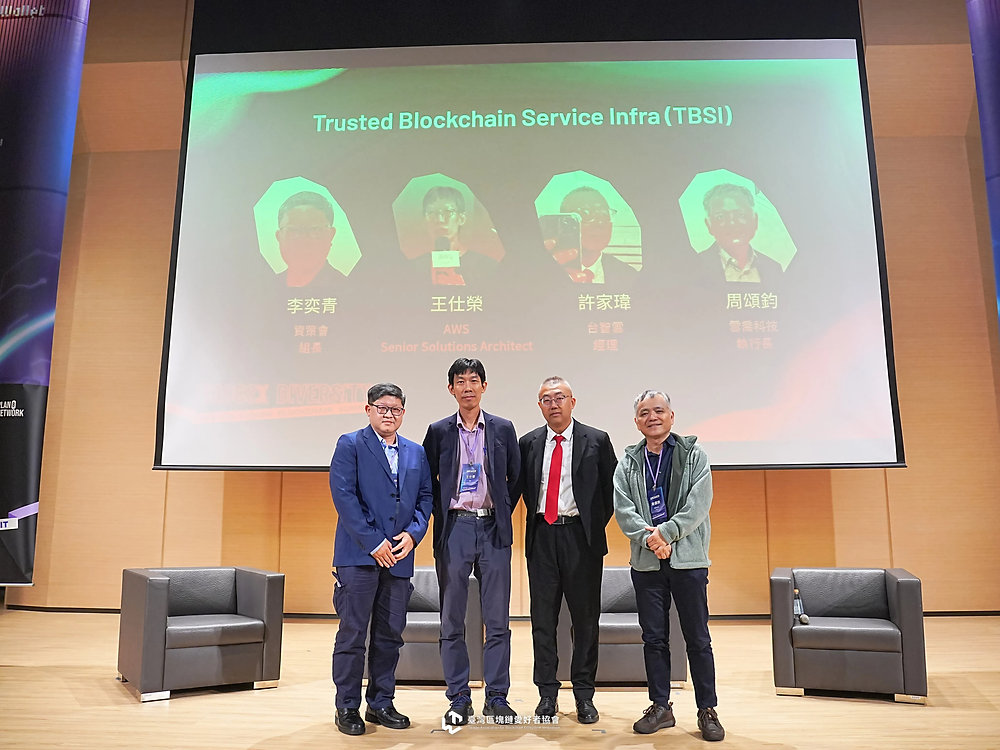
At this year's Taiwan Blockchain Summit, participants discussed the state and outlook of the Trusted Blockchain Service Infrastructure (TBSI), now the emerging consensus among Taiwan's consortium-chain operators. Li Yi-ching, head of the blockchain governance division at the Institute for Information Industry, said consortium chains had until now followed a pattern of one chain per application, which is expensive to maintain and raises questions about node trust. TBSI was therefore established, with the institute bringing consortium-chain operators together to standardise the underlying services for blockchain data exchange and build a cross-industry blockchain trust infrastructure for Taiwan. Hsu Chia-wei, a manager at Taiwan Web Service, a subsidiary of the ASUS group, said demand for TBSI is becoming clearer at the front of the market: customers increasingly understand that these products are not simply cloud services plus blockchain notarisation, but blockchain integrated into a complete cloud service, and that more comprehensive infrastructure such as TBSI is needed. Trusted data exchange increases social impact Chou Sung-chun, chief executive of Snowbridge Technology, said there are still few blockchain applications that touch everyday life. He gave as the clearest example the EU's vaccine passport during the pandemic, built to a W3C standard, which let citizens of EU countries verify the accuracy of that data as they moved within the union. There was no chain at the time, but it was an early form of a data trust architecture; the EU's EBSI (European Blockchain Services Infrastructure) now aims to carry out trusted data exchange through a consortium-chain structure. Speaking as a cloud provider, Hsu Chia-wei gave the example of emissions management, which could also use TBSI for data exchange. ASUS is a global manufacturer with six to seven hundred suppliers worldwide, and those suppliers' carbon footprints all count as manufacturing costs. Once carbon-footprint data is digitised and written on chain, suppliers can optimise it and produce carbon data reports. Li Yi-ching added that this pattern of exchange could extend to future carbon taxes and carbon credit trading, improving the competitiveness of manufacturing. Related reading: Meet TABEI Forum: bringing consortium chains to Taiwan and joining them to the ESG trend Consortium-chain consensus needs advocacy and government support Hsu Chia-wei said the government now needs to establish a standard for operators to follow, and that building a cross-industry consortium community is equally important in helping operators understand the benefits of a trusted data system built on blockchain. A consortium chain does not come about through a particular industry or a few companies developing behind closed doors. It requires standardising the technology and securing policy support to build a sound data trust system together. Li Yi-ching noted that TBSI completed its service quality specification at the end of June and looks forward to bringing in more participants.